

DoCoMo
DoCoMo

Welcome to Aichi Expo 2005

The Aichi World Expo officially opened here yesterday and “Japan has pulled out all the technological stops to show that its gadgetry and ingenuity is the best in the world.” Opposite Toshiba’s digital cinema is Hitachi’s virtual reality safari. Hitachi equips visitors with portable handsets that contain a prototype of its mu-chip, a processor slated to become the key component of future wireless devices, including mobile phones. As the handset is brought close to particular transmitters, it instantly downloads any information on offer in that area and displays it on a small screen.
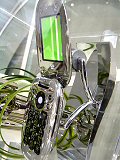
KDDI Designing Studio: Video Tour

KDDI Harajuku Design Studio TourJapan’s wireless industry provides some of the coolest mobile experiences on planet Earth. It should come as no surprise, therefore, that mobile players here are also masters at the street-level marketing of cell phones and wireless services — and KDDI’s Designing Studio is not only the latest over-the-top effort at creating a consumer-targeted mobile funland, it’s also the best. In today’s program, WWJ’s Gail Nakada speaks with the Studio’s general manager, tours five floors’ worth of interactive games, live handsets and mobile demos, and plugs into Harajuku’s ultimate mobile zeitgeist.
Some of Japan's Cool New Apps

In a telephone interview with a research company in Toronto last night, I was asked for examples of the coolest new applications or services in Japan. Without a doubt, I answered, mobile music and the Chaku Uta Full song download services are really eating up packet bandwidth. The week before last, KDDI announced that the cumulative downloads for EZ Chaku Uta Full (provided via the CDMA 1X EV-DO WIN network) had surpassed 3 million as of 1 March 2005, less than four months after the 19 November 2004 launch. The company added that the 1 million and 2 million milestones were achieved on 5 January and 5 February, respectively.

From the WWJ Newsletter. Log in to read full article. To receive WWJ’s free email newsletter, subscribe here.

Dilithium Networks Announces Joint Collaboration Agreement with NTT DoCoMo

Dilithium Networks announced it has concluded a joint collaboration agreement with NTT DoCoMo, Inc. to collaborate on the development of 3G terminal test cases to advance video telephony interoperability test solutions. Dilithium Networks will, with support from NTT DoCoMo, design a broad suite of IOT test cases. Dilithium Networks will incorporate these cases into its Dilithium Networks Analyzer (DNA). Using DNA, 3G terminal vendors and mobile operators will be better suited to test new handsets being developed, as well as testing terminals software upgrades to ensure high interoperability performance.

It's Quiet on Tokyo's Mobile Street. Too Quiet.

Checking headlines around the Web yesterday and today, I was struck by the eerie silence on Tokyo’s mobile street. There is a ton of coverage on the Livedoor/Fuji TV take-over battle, but that’s largely a Web/media topic and not really related to mobile. Where’s all the silence coming from? And could it be related to Vodafone, Softbank or flat-rate mobile voice calling? To be sure, we’re not totally lacking mobile news; DoCoMo have posted a couple of releases in the past two weeks, including the 22 February announcement of Mobile FeliCa, see WWJ’s video coverage here and the 8 March notice on the launch of the N700i and P700i 3G FOMA handsets. Similarly, KDDI have some releases up (but only in Japanese; nothing in English since 8 February), notably on their new W31S music-player form-factor celly from Sony Ericsson.

Japan Rail, DoCoMo State Mobile Suica Plans

Mobile Suica Launch VideoRecently, East Japan Rail (JR East) and NTT DoCoMo held a press event in Tokyo to announce the January 2006 start of “Mobile Suica” which will allow i-mode phones to serve as train tickets. WWJ’s Gail Nakada filed her report here and today’s video program gives you a ring-side seat to learn how Big D and JR plan to win over the hearts, minds and wallets of millions of mobile-phone using commuters (and most of them are). As you’re watching today’s press conference, there are several key points to keep in mind. First, until now, it has in fact not been possible to use your phoneas a train ticket in Japan. Despite all the live demonstrations, trade show hypeand media speculation around FeliCa, the FeliCa-based Suica cards used by JR andthe FeliCa-based i-mode handsets sold by DoCoMo have been incompatible. Yes, you could use your FeliCa handsets to buy a ticket, but the phone itself was not the ticket.