DoCoMo
DoCoMo

JR East Cranks up Cell-phone Tickets

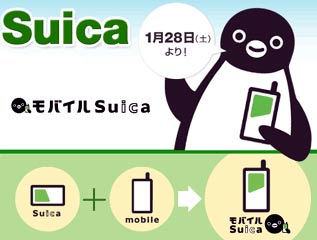
A new service using mobile phones as smart tickets for trains operated by East Japan Railway Co. began Saturday. The service, named Mobile Suica, combines the service of JR East’s Suica IC card and mobile phone service offered by NTT DoCoMo Inc. and KDDI Corp. Once customers pay for train fees or train passes online, they can go through JR wickets in and around Tokyo by just holding their handsets over card readers on the ticket gates, according to the railway. (Mobile Suica is finally in operation! See today’s Viewpoint — Eds.)

Japan Rail Launches Mobile Wallet Phone Service

Japan Rail Launches Mobile Wallet Phone Service by Mobikyo KKOn a sunny Saturday morning here in Tokyo, Japan Rail launched their long-awaited Mobile Suica service, which will allow customers to use their FeliCa-enabled Osaifu ketai (wallet phone) to get into the station simply by swiping their handset past the turnstile reader. The service will be available at almost 900 stations located in the Tokyo, Sendai, Niigata, and Kansai regions. On roll-out day the system supports 12 handset models from DoCoMo and KDDI; none of the three available Vodafone units will be supported at launch. Interesting to note that DoCoMo’s latest F702iD, just announced last week, will be accepted as well. Until now, it has in fact not been possible to use your phone as a train ticket in Japan. Despite all the live demonstrations, trade-show hype and media speculation around FeliCa, the FeliCa-based Suica cards used by JR and the FeliCa-based handsets sold by DoCoMo, KDDI and Vodafone have been incompatible. As the well-established ‘Suica’ card is also accepted at many shops (including Bic Camera, a major electronics chain) in and around JR stations, this move will undoubtedly push up the volume of mobile payments made in 2006. It should come as no surprise that NTT DoCoMo announced on 26 January that sales of their FeliCa handsets passed the 10 million mark, a notable increased from the stated [.pdf] circulation of 7.7 million units in November 2005.

Vodafone Japan New 3G Phones: Details, Audio Interview

Last week was a rare clean sweep in Japan’s tooth-and-nail handset race as each of the Big Three carriers in turn announced multiple new 3G models at splashy press events. Across the field, we saw an onboard 4-GB hard drive and a digiTV phone from KDDI, the 702i ‘designer’ models from DoCoMo and Japan’s first Samsung phone and new 3G data services from Vodafone. Vodafone Japan New 3G Phones: Details, Audio Interview
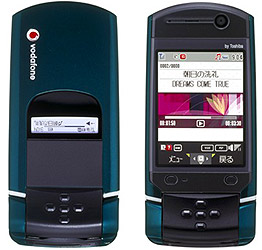
It’s no simple coincidence that this week the carriers are announcing their third-quarter financial results: it’s super vital to have a flashy new set of handsets to point to when presenting your report card to the analysts in Tokyo and London. Also, spring is the premiere mobile sales season in Japan and the models announced last week should hit the streets around cheery blossom time.

If Vodafone Japan’s market troubles in the past couple of years can be blamed on handset mix, then the new phones may go a long way to to fixing Big Red’s market position. Today’s WWJ Portable Reportable MP3 audio report features an interview with Vodafone Japan from last week’s press event with in-depth details on their new 3G models, which include phones from Samsung, Toshiba, Sharp and NEC, and comments on competitive positioning in the market.

DoCoMo: 3G Phone with Windows OS

NTT DoCoMo and High Tech Computer Corp. (HTC) announced today they have agreed to market HTC 3G FOMA handsets with Microsoft Windows Mobile 5.0 operating systems. DoCoMo and HTC aim to launch commercial sales sometime in the second half of 2006. The phones will be targeted at corporate users and offer enterprise services such as synchronization with MS Windows Server and MS Exchange Server. The phones will also provide dual-mode W-CDMA and GSM/GPRS connectivity, Wireless LAN and a QWERTY keyboard. (Looks like another nice boost for Microsoft in the Japan mobile space — Eds.)

Info Plant Mobile Users Survey

Online market researcher Info Plant has released the results of a survey on cell-phone functions and services. The company conducted a survey of 7,905 NTT DoCoMo i-mode users nationwide, 12-23 December 2005. When asked which functions and services they usually use that are available on their handsets, 85.4 percent of respondents answered “alarm,” followed by 83.3 percent for “camera (for still images)” and 81.6 percent for “ring tone.” When asked which functions and services they wish to have, the top favorite was “TV,” followed by “GPS navigation” and “pass/ticket for train and bus;” “key,” “ID card,” and “anti-crime buzzer,” were among the top 10 answers.

KDDI Introduces Seven New 3G Handsets

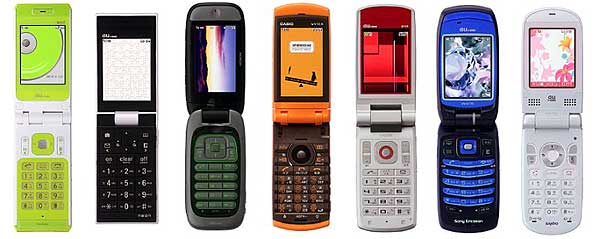
This week was a new-cell-phone-announcement triple-play! Following DoCoMo on Tuesday and Vodafone yesterday, KDDI’s au brand held a press conference this afteroon at the super-swank New Otani hotel to unveil an impressive spring line-up. From L. to R. (below): Toshiba’s W41T with Japan’s first built-in 4GB HDD, the slick-styled Neon, is the latest addition to the in-house Design Project; Hitachi’s W41H ‘One-Seg’ digital TV phone; Casio’s W41CA, featuring a FeliCa mobile wallet; Kyocera’s W41K is a ‘Full Function’ camera phone with a 3.2-megapixel cam; SonyEricsson’s W41S is also FeliCa IC-enabled; and finally the Sanyo W41SA, which has an interesting handwritten character scanning application. The new fleet will hit store shelves starting in February along with the introduction of an enhanced Listen Mobile Service.

KDDI Introduces Seven New 3G Handsets by Mobikyo KK