DoCoMo
DoCoMo

Mobile Phone Adoption Rates in Japan

Research and Markets have announced the new Wireless World Forum report: Japan Mobile Market 2006 – Your Statistical Guide To Understanding The Mobile Opportunities in Japan 2006-2007. Stating that data from the “Japan Mobile Market” statistical handbook shows that future growth in the Japanese mobile market will be centred on the under 14s and over 55s as 100% penetration is reached in all other age groups. Penetration in the 5-9 year-old age group will more than double from 29% in 2004 to reach 64% in 2007 but the largest number of new subscribers in 2006 will come from the 55-65 age group, with 1.62 million new customers.

KDDI's Competitive Edge in Japan

Over the past 12 to 18 months the mobile division of KDDI, known here as ‘au,’ has been leading the way in Japan’s cellular marketplace. During a recent interview at the 3G World Forum, one European visitor asked the seemingly obvious question, “What is the main reason for their success?” KDDI au's Competitive Edge in Japan by Mobikyo KK

The reasonable answer is that it’s actually a combination of several factors, but one thing stands out. Compared to the NTT DoCoMo and Vodafone business models, au has a very tight focus on the domestic market. Their attention to detail in customer service and product offerings is not challenged by how the product mix and content offerings might fit into the company’s global strategy — and it shows. This has allowed au to take the lead in areas like GPS, flat-rate data and faster networks, all provided to the consumer on affordable price plans. The carrier now offers a full suite of popular and useful services ranging from Navitime, EZ auctions, EZ book, EZ channel, EZ games, and EZ FM to (recently introduced) mobile IM (‘Hello Messenger’), mobile blogging (‘DuoBlog’) and Lismo.

Looking again at au’s recent blitz of cutting-edge models at Designing Studio last week, just in time for Japan’s peak spring sales season, we were truly impressed; it will be a tough choice for shoppers. The phones and services strongly illustrate one of the most fundamental and important learnings about Japan’s mobile success that we’ve been trumpeting for years.


NTT Planning WiMax Tests

NTT, Japan’s largest telecommunications group, plans to test WiMax technology as early as next month. Group companies will work together on trials of WiMax technology, said Masao Nakamura, president and CEO of NTT DoCoMo. Nakamura, who shared only a few details of the planned tests, confirmed that NTT DoCoMo would be one of the participants. Previously, NTT DoCoMo said it intended to push the 3G technology WCDMA to faster speeds. The “Super 3G” service will offer data transmission rates as high as 100Mbit/s and could be available in metropolitan areas as soon as 2008.

DoCoMo's Prototype HSDPA Handsets

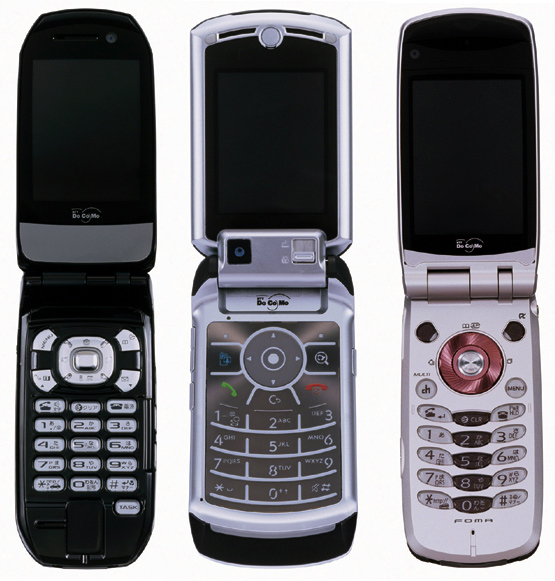
NTT DoCoMo just announced three prototype high-speed downlink packet access (HSDPA) handsets developed with Fujitsu, Motorola (Wow!) and NEC. HSDPA, a high-speed packet transmission technology standardized by the Third Generation Partnership Project, offers a theoretical maximum downlink speed of about 14 Mbps. The handsets will be demonstrated at DoCoMo’s booth at the 3GSM World Congress 2006 in Barcelona, Spain from February 13 to 16.

DoCoMo aims to start HSDPA services sometime between July and September 2006 (as per our recent bold prediction for 2006 — Eds).

DoCoMo to Expand Flat-rate Data Tariffs

DoCoMo said this morning they would expand the number of calling plans with which users can bundle flat-rate data. Until now, to get flat-rate data, you also had to select one of two rather pricey FOMA voice plans, such as the Type M Plan for 6,930 yen per month; with flat-rate costing 4,095, this meant that flat-rate data cost about 11,000 yen per month! Starting 1 March, all new FOMA billing plans introduced after 1 November 2005 will be eligible for flat-rate.

DoCoMo Results 3Q2005

DoCoMo have just posted their financial results for the quarter ending 31 December 2005. Operating revenues came in at 3,582.2 bn yen, down 1.7% year-on-year — not bad considering the downward trending ARPU. Operating income was 693.5 bn yen, down 7.7% and income before taxes was 811.2 bn yen, down 32.1%. The lower profits indicate that costs to operate and expand the 3G service continue to remain high. But there are few companies — much less 3G carriers — faced with the ‘problem’ of calculating taxes on 8 billion bucks of profit.