Wireless Watch Japan
Search Results for: smartphone

DoCoMo Announces BlackBerry for Japan

NTT DoCoMo, Inc. and Research In Motion (RIM) announced today that DoCoMo will start marketing RIM’s BlackBerry handheld devices to its corporate customers in autumn 2006. The BlackBerry handheld devices to be sold in Japan will operate on both W-CDMA (UMTS) and GSM/GPRS networks and will be useable around the world for voice and data communications. BlackBerry Enterprise Server software tightly integrates with Microsoft Exchange, IBM Lotus Domino and Novell GroupWise, and enables secure, push-based wireless access to e-mail and other corporate data.

Gaming Set to Repeat Mobile Music Success

Mobile Music Hot but Mobile Games will Blaze! by Mobikyo KKAs mobile music settles into a steady mainstream growth cycle, with now-well-established hardware and content offerings, many industry watchers are looking towards the Next Big Thing. We think they need look no further than portable gaming, which is set to take mobile by storm. All the ingredients for mobile gaming success are in place: key platforms, faster 3G networks, affordable and flat-rate data, and a keen, heavy using youth demographic that continues to display a never-ending quest for hardware upgrades. Take a look around the streets of Tokyo, and the conclusion is unmissable: gaming for mobile devices is set for impressive growth in the next few years.

To date, the limiting factor has been the actual devices, as it was at one stage with music. The Nintendo DS and Sony PSP, much like Apple’s iPod, have proven to be early major hits as stand-alone units, having sufficient onboard CPU and memory capabilities to run some intensive games. In view of the success of porting the well-known ‘Walkman‘ onto mobile phones, can it be that long before we see the PSP label on a prototype cell phone from Sony Ericsson?

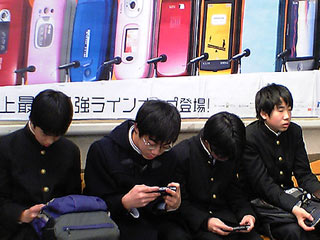
The photo tells it all. Taken recently by WWJ digital media director Lawrence Cosh-Ishii in suburban Tokyo, it shows a group of mid-teen boys waiting for a train at Shimo-Kitazawa station; all are playing with a PSP, blissfully ignorant of the huge poster for KDDI/au’s new music campaign. Note also that the recent BREW 2006 Conference issued a release with the news that Qualcomm and Microsoft will port MS ‘Live Anywhere’ for X-Box 360 gaming onto BREW-enabled mobile handsets. If you don’t think these tech giants have got it right, just watch what the kids are doing!


DoCoMo 3G Overtakes KDDI

As WWJ predicted last month, the latest Telecommunication Carriers Association numbers confirm that DoCoMo has indeed gone on to ‘Grab [the] 3G Lead from KDDI.’ OK — so the news isn’t startling given that the trend for the past several months has been growing in DoCoMo’s favor. The news that has been below almost everyone’s radar screens, however, is the exceptional performance of upstart PHS carrier Willcom and its success in attracting new customers compared to third-place 3G carrier Vodafone. The folks over at Willcom posted a net subscriber gain of 80,200 in January compared to Vodafone’s paltry 17,600 result.

Vodafone Japan 3Q Results Released

Extract: Vodafone K.K.’s 3G devices increased by 564,600 in the quarter, bringing the number of 3G subscribers to 2,318,200, whilst market share of 3G net additions remained fairly constant throughout the quarter at just over 10%. Blended ARPU for the quarter was down 3.7% year on year, an improvement from the 5.4% fall recorded in the quarter to September. The continued fall in ARPU reflects the loss of higher value customers in the previous year and competitive pressures on pricing. Blended ARPU for the quarter was down 3.7% year on year, an improvement from the 5.4% fall recorded in the quarter to September. The continued fall in ARPU reflects the loss of higher value customers in the previous year and competitive pressures on pricing. The improved trend is due in part to the positive impact from the new range of flat-rate plans, which are generating additional usage. Service revenue fell 4.5% year on year due to the decline in ARPU. Voice revenues fell 6.2%, with non-voice revenues broadly stable. The improvement versus the previous quarter can be attributed to an improved ability to retain customers, resulting from a better handset line-up and service offering. (WWJ subscribers log in for more details).

Wireless Watch Japan – Top Stories for 2005

Wireless Watch Japan - Top Stories for 2005We published 596 articles on Wireless Watch Japan in 2005 and thought you might enjoy looking back at the most popular Japan mobile industry highlights from the year. The links below, three from each month, represent the two top stories (by volume of visitor requests) and a third which we consider a significant development in that 30-day period.

It’s been a year of explosive year in the mobile world and 2006 is set to be even much more interesting with faster mobile networks, more powerful handsets and compelling contents settling into the mainstream. Here in Japan, we are expecting a dramatic increase in m-commerce adoption, driven in part by Mobile Suica’s launch, set for later in January and the start of ‘One-Seg’ digital TV broadcasting starting — on all three carriers — on 1 April (no joke). We also see a potential increase in churn as a result of the (belated) introduction of number portability and with three new carriers entering the market, even DoCoMo is concerned.

One of the more obvious action areas in 2006 will be the increase of M&A activity at all levels; in particular, look for consolidation in the Japanese handset market. Meanwhile, lets boldly predict that we’ll have at least a few 3.5G (HSDPA) phones on the streets of Tokyo by this time next year. Interesting times ahead, indeed. Get all the skinny after the jump!

Latest Release of Skype for Mobile Japan Friendly

Latest Release of Skype for Mobile Japan Friendly by Mobikyo KKSkype has just introduced two new, updated clients for the Windows Mobile 5.0 platform: Skype for Pocket PC Beta version 1.2 and Skype for Pocket PC low CPU Beta version. This latest release claims full support for low-CPU devices with 300+ MHz processors. Users will be able to download and install the Internet telephony application with Danish, Dutch, Italian, Japanese, Korean, Norwegian, Portuguese Brazil, Russian, Spanish, and Swedish language plug-ins and it also supports the new call-forwarding feature and landscape mode for 240×240 and 480×480 screens.

We expect to see even more buzz on this development in the local wireless community with Willcom’s new Zero3 dual-mode Smartphone, made by Sharp, which just hit the street here last week. In fact, eager buyers were lining up to order the unit in early December and we’ve even noticed a Wiki site [Japanese only] dedicated to the Zero3, one of the hottest QWERTY handsets available in the domestic market.

The potential of VoIP flat-rate voice calling for mobile — including long-distance — takes another huge step with this announcement. Yes, it’s a narrow niche of users who will adopt this here… for now. However, for incumbent cellcos, the kanji is on the wall and they will undoubtedly have to respond to this truly disruptive technology if they wish to save their voice-centric business model.