Wireless News
Wireless News

Motorola Launches M1000 3G SmartPhone Developed Jointly with NTT DoCoMo

Motorola, Inc. a global leader in wireless communications and a mobile phone market leader in North Asia today announced the launch of the FOMA M1000, the world’s first-ever WLAN-integrated W-CDMA and GSM/GPRS dual-mode smartphone. Developed jointly by Motorola and NTT DoCoMo, the new handset is modeled on Motorola’s 3G A1000, which won high acclaim from consumers in Europe and Asia. The M1000 will be available in Japan from July 1, 2005 through NTT DoCoMo channels. (See Wireless Watch Japan’s Video Report from the press launch)

Panasonic Ramping up Production

Panasonic Mobile, will more than double the number of handset models for export this fiscal year to about 10, according to a report in the Nikkei Shinbum. Panasonic has already made agreements with more than 10 carriers, mostly in Europe and projected shipments of about 8 million units this fiscal year, up 10% from fiscal 2004. The new models will be introduced starting in July through year-end, primarily targeted for Europe and China.

VoIP in the Palm of your Hand

Anyuser Global’s tiny VoIP IMphone flash drive brings voice communications to any PC. Scheduled to go on sale in Japan this August, the unit streamlines installation into a USB plug and play solution. All the VoIP software and circuitry is packed right inside along with 64MB of flash memory. That means PC vagabonds can use it on any machine with an Internet connection – at Internet cafes, friends houses, conducting “Alias” style international intrigue. Not bad for a unit the size of a packet of gum.

Lucent Technologies and Japan's eAccess Complete Successful HSDPA 3G Tests

Lucent Technologies and eAccess Ltd., today announced that the two companies have completed successful High-Speed Downlink Packet Access data calls as part of a third- generation (3G) Wideband-CDMA (W-CDMA) network trial announced earlier this year. The testing took place in May and used the 1.7 Gigahertz (GHz) spectrum band that is being made available in Japan for the deployment of mobile service. Following these successful tests, the two companies plan to conduct a field trial in commercial and residential areas of Tokyo in the coming months. The trial will include deployment of an HSDPA-enhanced W-CDMA network in the 1.7 GHz spectrum band, and also will incorporate Lucent’s IP Multimedia Subsystem (IMS) solution.

Mobile Phones Jump and Jive at 3G Wireless Disco

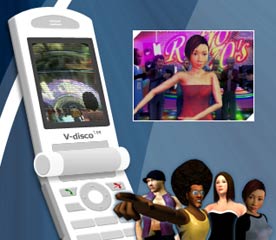
Mobile Phones Jump and Jive at 3G Wireless DiscoHong Kong’s Artificial Life turns 3G handsets into funky dance machines via V-disco, a wireless subscription site combining chat, music streaming and music downloading to mobile phones with interactive 3D graphics and animated virtual avatars. V-Disco will initially launch throughout China, Hong Kong and Southeast Asia. Japanese 3G handsets should come on line in the very near future. The company plans to take on Japan’s 3G market full throttle and is currently in negotiations over its debut here.

Users and visitors to the virtual disco select an avatar persona for themselves and join the party in the club’s three interactive levels. Club goers select genres and songs from the club list, listening to their tunes while their avatar strolls along chatting – if they choose – with other party people in real time and checking out 3D animated characters moving to the beat. Avatars act as guides, companions or dancing doppelgangers. Though the figures retain a slightly cylindrical, rubbery look the V-Disco has a fun Dance Dance Revolution feel to it with a good backbeat.

NTT's New B2B Via Voip Package: Click-to-Connect

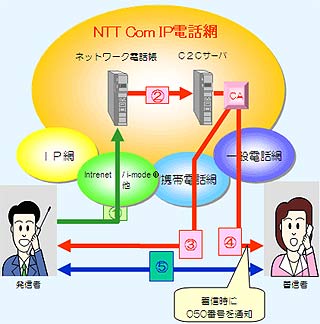
NTT's New B2B Via Voip Package: Click-to-ConnectNTT Comm, part of telecom giant Nippon Telegraph and Telephone is muscling in on free IP services with an IP telephone and mobile phone hybrid package for corporate and retail customers. Subscription-based “Click-to-Connect,” or C2C, enables mobile handsets from any provider to connect to NTT’s IP network by dialing a 050 prefix. Users receive assigned phone numbers attached to the prefix and NTT manages the whole system on their i-mode and Internet network.

Internet telephony, that cheap and cheerful, occasionally fuzzy alternative to conventional phone calls, has been plagued by some of the same financing problems of Internet portals — how to turn a steady profit from a free or at least inexpensive service. NTT Comm’s plan surgically removes that pesky ‘R’ from free and creates a fee-based plan that works through business models already in place. Conservative Japanese companies unwilling to commit to unfamiliar IP protocols are comforted by that rock-solid NTT logo anchoring Click-to-Connect.

Company subscriptions to the IP service allow employees to use their own mobile phones for business-related calls — plus C2C also works on conventional phones, PHS and IP models. That frees companies from providing business-use phones to workers. Each company manages their corporate subscription via a dedicated Website. Corporate charges start at 1,050 yen per phone number for between 1-50 phones. For 500 phones or more, that charge drops to 787.5 yen. Over a fixed telephone line or IP telephone, a three-minute call will cost 8.4 yen; a one-minute call on a cell phone, about 18 yen or around 54 yen for three minutes. Savings could be as much as 30 percent compared to standard cellular rates which can charge as much as 90 yen for a short three-minute call. Retail rates have not yet been released.