HSDPA
HSDPA

DoCoMo to Start HSDPA with N902iX Handset

DoCoMo just announced that they will launch a High-Speed Downlink Packet Access (HSDPA) service on August 31, when they start sales of Japan’s first HSDPA-compatible handset, the 3G FOMA N902iX HIGH-SPEED. In FOMA HIGH-SPEED areas, the N902iX is capable of packet downlinks of up to 3.6Mbps, approximately 10 times faster than current FOMA handsets. From August 31, all of central Tokyo will be included in these HIGH-SPEED areas, and all major Japanese cities will be covered by the end of October.

Casio to Deliver 3G Data Cards to EU

CASIO Europe and Sierra Wireless have announced a marketing agreement that brings 3G wireless connectivity to CASIO mobile data collecting terminals in Europe. Under the terms of the agreement, the IT-3000, DT-X10, and new DT-X11 mobile data collecting terminals will support Sierra Wireless’s AirCard 850 wireless wide area network (WWAN) card for HSDPA UMTS networks. With the AirCard 850 card, CASIO’s mobile data collecting terminals can transfer data via UMTS, HSDPA, EDGE, GSM, and GPRS networks worldwide.

NEC, Panasonic and TI Form Handset JV

NEC, NEC Electronics, Matsushita, Panasonic Mobile Communications and Texas Instruments just announced that the five companies have signed an agreement to establish a new joint venture company. The company will conduct global development, design, and technology licensing for a hardware and software communications platform to manage the core communications functions for 3G handsets. The new company, Adcore-Tech Co., Ltd (“Adcore-Tech”), is scheduled to be established in August, 2006 at the Yokosuka Research Park in Yokosuka, Japan, with approximately 180 employees.

(As we stated on Tuesday this week: “expect a formal announcement in the coming days.” — Eds.)

DoCoMo Working Towards Super 3G

DoCoMo has just announced that starting today it will accept proposals from suppliers for development of equipment for Super 3G base stations and handsets. DoCoMo will select one or more suppliers for each of these categories around October and aims to complete the technology with the selected suppliers before the end of 2009. The Super 3G standard is expected to provide superfast downlink data rates of over 100Mbps and uplink data rates of over 50Mbps, low-latency data transmission, and improved spectrum efficiency.

Motorola Razr, Designer Phones in DoCoMo 3G Summer 7-Series

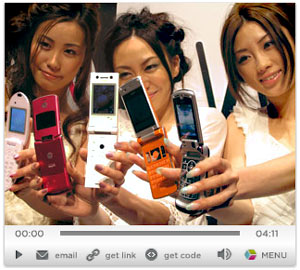
Motorola Razr, Designer Phones in DoCoMo 3G Summer 7-SeriesDoCoMo today announced six summer 3G handsets, including ‘7-Series’ models from US maker Motorola, Sharp, NEC, Panasonic and Mitsubishi. The Japan-made models include three ‘designer’ phones, with ultracool shapes and colours conceived by noted Japanese design personalities, while Motorola joins the show with their M702iS and M702iG — the latter evidently based on the newest version of the widely popular ‘RAZR’ series, the Razr V3X.

The company unveiled the phones at a flashy press event held at the Harajuku Quest event space in central Tokyo. The three designer models, from Mitsubishi, Panasonic and NEC, offer a range of trendy colors including ‘lilac mirage’ and ’round coral’, and feature square, oval and bevel shapes based on the clam-shell form factor. DoCoMo’s choice of outside designers to create custom models is neither the first for the carrier nor for Japan and continues a popular (and lucrative) trend long developed by KDDI and Vodafone.

All phones unveiled today include, in varying mixes, the carrier’s stripped-down ‘3G-lite’ voice and data services, including roaming, ‘Chaku-moji’ (which lets the caller enter a short message that will appear on the receiver’s phone as it rings), network phonebook backup, network lock-out of a lost phone, Deco-mail (HTML mail), i-Channel and music playback. But while the carrier presented the phones as the unified ‘7-Series’, there are significant differences between the domestic and US models. The Motorolas fail to provide all of the signature lite FOMA services (lost phone lockout, PushTalk, removable memory) but they do roam, while the Japanese models don’t roam.


DoCoMo Testing 2.5Gbit Wireless Network

According to a recent report, DoCoMo is testing a new network standard that could send DVDs to handheld devices in about 10 seconds! The prototype uses a combination of Multiple In Multiple Out (Mimo) technology and a tweaked version of quadrature amplitude modulation (QAM) and is capable of delivering 2.5Gbits/sec to users travelling at 20Km per hour. Mimo, which is used in a the draft 802.11n Wifi standard and turbo versions of existing Wifi products, uses a combination of several antennas and clever processing to boost data rates.