

Tokyo's amazing week: UK/Jpn JV, 'SoftBank Mobile' and MNP
Watching the business of wireless in Japan just keeps getting better!
Last week brought a slew of new announcements, including news of the JPY11 bn SoftBank/Vodafone joint venture, confirmation that the company formerly known as Vodafone KK will henceforth be known as ‘SoftBank Mobile’ and details on the long-awaited MNP (mobile number portability) implementation. Subscribers can access WWJ’s insight on the first two in today’s Viewpoint (here), but read on below for our take on MNP — possibly the biggest revolution in Japan mobile since i-mode itself.
First, a little history.
Until now, the Big Three cellular carriers (DoCoMo, KDDI/au and Vodafone), as well as the smaller PHS carriers (Willcom, Astel, etc.), have run their networks as independent — and highly competitive — fiefdoms. There has been nothing like number portability or, for that matter, portability of any other service/feature. If you switched carriers, you lost your number…
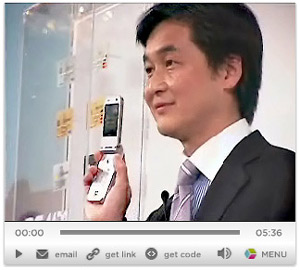 DCMX: Is it a phone that can buy stuff or a credit card that can make calls? NTT DoCoMo is hoping that millions of spend-free consumers won’t know or care about the distinction and will simply use the new ‘DCMX’ credit-card phone for, well, pretty much everything. For small, daily purchases — like a six-pack and a take-out bento lunch — use the phone’s e-money FeliCa chip with no authentication required; for larger buys (a cool Louis Vuitton bag from the Omotesando boutique), use the DCMX credit-card function with a swipe and a PIN code; later, the phone will eyeball you for biometric authorization. “We wish to combine telecoms with financial services,” says DoCoMo’s Mr i-mode, Takeshi Natsuno, in today’s video program — and if there’s a cellco anywhere in the world that can afford the value-chain coordination costs to deploy a workable phone/credit card combo, it has to be NTT DoCoMo.DCMX is a logical progression from the carrier’s popular ‘o-saifu keitai’ IC-chip handsets that can store value onboard for small, daily purchases, and the launch announcement confirms DoCoMo’s strategic course aiming squarely at making the network-connected phone the payment method of choice for millions of Japanese. Maybe one day something this useful will be offered by carriers elsewhere?