

DoCoMo
DoCoMo

DoCoMo to Offer Info-Capture FeliCa

DoCoMo has announced plans to offer an information-capture function, called ToruCa, in their new “Osaifu-Keitai” (Wallet-Phone) compatible handsets to be released this winter. ToruCa will enable users to obtain information by simply waving their phones in front of dedicated reader/writers installed at restaurants, theaters, music stores, arcades and other establishments. For example, when a user buys a CD at a store using the “Osaifu-Keitai,” they can simply wave their DoCoMo phone in front of the store’s reader/writer to retrieve extra information about the CD, artist, etc., and possibly even a promotional coupon offered by the artist’s recording label.
Locked into the Mobile Loop

Locked out of your Tokyo apartment? Forget the locksmith; call the phone company. Alpha Corp. has come up with a door locking/unlocking system that works with DoCoMo’s FeliCa IC card-equipped mobile phones. Similar systems have been around for several years, but this all-in-one door handle and locking unit can be installed on any existing entry without any special wiring. Previously mobile-phone activated locks were only available on new hot-wired apartment buildings. An extra subscription service even allows owners to check over their mobile if doors are locked or not (see also: Mobile FeliCa Trial Launch: Video Report from Dec. 2003).

Ticket Guru Pia Goes For 3G Gaming

Japanese ticket and entertainment publishing powerhouse Pia has made its first tentative foray into mobile gaming in a tie-up with DoCoMo. Pet simulation game AquaZone swam onto i-mode screens a few days ago through Pia’s partnership with Frontier Group and its subsidiary Pia Digital Communications [press release in Japanese]. The PC version of AquaZone’s virtual Aquarium is already a hit with fish fanciers here and even on the small screen DoCoMo’s Foma 3G graphics keep the colors bright and clear. Subscriptions cost 315 yen per month (US$2.87).

Japanese Cell Phone Sales Set to Surge in 2006

Japanese Cell Phone Sales Set to Surge in 2006

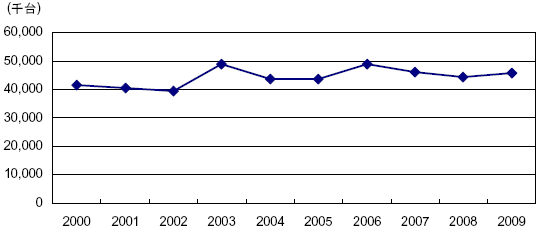
Market research firm Gartner Japan has good news and bad news for cell phone manufacturers and telecos. The company predicts Japanese handsets sales could reach 49 million units in 2006 as mobile number portability finally makes it debut and consumers trade up to faster, smarter handsets on their carrier of choice. That’s good news since sales for 2005 are looking rather flat especially compared to those halcyon days of 2003 when the debut of the camera phone helped drive sales to over 48 million units. Bad news is that Gartner’s research [.pdf in Japanese] indicates sales will fall again sometime in 2007 once consumers have replaced their current handsets.

Of course it doesn’t take costly research to know telecos here have a lot to worry about. With the domestic cell phone market fast reaching saturation point DoCoMo, KDDI and Vodafone will have to depend not only on handset replacement but rolling out comprehensive mobile consumer, retail, and data-related services — both in-house and through partners — to retain customers and keep income flowing in the right direction.

Jazelle for New DoCoMo 3G Phones

ARM has announced that their Jazelle technology will be deployed in a new line of FOMA handsets by NTT DoCoMo. Emerging applications such as mobile games and business tools place increased performance and power demands on Java technology-enabled handsets. Through ARM’s partnership with Aplix Corporation, a global leader in deploying Java technology in mobile phones, ARM Jazelle technology is being adopted in the DoJa/Java platform for FOMA handsets, which is being jointly developed by Aplix and NTT DoCoMo.

New 3G Phones from Vodafone Japan

New 3G Phone from Vodafone JapanJapan’s lost souls and the musically minded are targets for two new W-CDMA 3G handsets from Vodafone Japan, the 903T and 803T, both by Toshiba. Scheduled for an October release, the 903T finally puts Vodafone on the real-time mobile GPS navigation map (rivals DoCoMo and KDDI have had network GPS phones for some time). Vodafone’s “Live Navi” navigation portal goes the competition one better with the addition of GPS global roaming options in the UK, Hong Kong, Holland, Spain and Germany — with more countries to follow. Of course, international roaming and Vodafone live! communication charges will apply, which might make it cheaper just to buy a guidebook.

Here in Japan, the navi service will map out routes according to specialized needs — like fewer stairs or covered access for when those typhoons hit. Vodafone’s main partner in mapping is well-known navigation data supplier Zenrin, which handles most of the live walk-through navigation and panorama shots via a split screen to show users just what they should be seeing on their route. Other partners specialize in train and subway routing, area-based restaurant maps or shopping information, as well as an international travel info site.