

DoCoMo
DoCoMo

DoCoMo Results for 1Q FY2006

Consolidated financial results for NTT DoCoMo and its subsidiaries for the three months ending June 30, 2006. Operating Revenues were 1,218.6 bn JPY (up 2.7% YonY), operating income was 272.7 bn JPY (down 5.2% YonY), income before taxes was 274.4 bn JPY (down 22.4% Y on Y) and net income was 163.5 bn JPY (down 21.3% Y on Y). The significant dip in year-on-year returns is attributed to the company’s sale of Hutchinson 3G assets in the compared period of 2005. The analyst meeting live video cast will begin here shortly (WWJ subscribers log in to access mp3 audio of Q&A session with media, in English).
Proof is in the Mobile Pudding

The good folks over at CIAJ (Communications and Information Network of Japan) issued a press item last week to announce results of their annual study on cellular phone use. According to CIAJ, “The study aims to capture on-going changes in the domestic mobile communications market and has been conducted since 1998.”

The study includes some interesting results related to actual usage of mobile Internet services, including email, music, GPS, mobile TV, e-wallets, number portability and more. The organization says they mailed questionnaires to 600 cellular phone users (male: 303, female: 297; by age group, under 20: 102, twenties: 101, thirties: 108, forties: 95, fifties: 95, sixties and above: 99) residing in the larger Tokyo and Osaka metropolitan areas from the end of March through April, 2006…

DoCoMo Ready to Roll HTC Smartphone

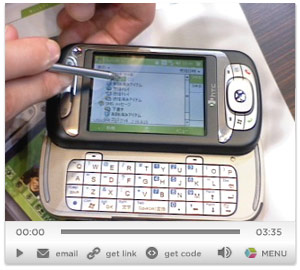
DoCoMo Ready to Roll HTC SmartphoneNTT DoCoMo and High Tech Computer Corp. (HTC) recently announced that they will start sales in late July of their new “hTc Z” smartphone, equipped with the Microsoft Windows Mobile 5.0 Japanese-edition operating system. The hTc Z will enable a variety of useful mobile business solutions using Windows Server and Exchange Server, in addition to 3G, Bluetooth, Wi-Fi and many add-in applications. DoCoMo plans to sell the handsets to corporate customers as part of its “comprehensive business solutions” effort.

We have a quick hands-on demo video for you on this one shot at DoCoMo’s booth during last weeks Wireless Japan event out at Tokyo BigSite. The full specs [.pdf] are available Here.

DoCoMo Shows Sound QR Technology

DoCoMo labs has demonstrated that they can insert audio data on broadcast signals – in music and voice – which can be translated by enabled mobile phones into text messages and URL links. The so-called “Sound QR” uses OFDM modulation technology which is transmitted in parallel by using two or more frequencies at the same time to suppress the influence of area noise and address the potential tone quality deterioration.

Adobe Japan Plans Revolution

Adobe, which was established in 1982, has 54 overseas offices and more than half its revenue comes from outside the United States. Japan accounts for about 20 percent of revenue, positioning itself as the second-largest country in these terms. It boasts advanced mobile devices and is likely to continue to be one of the strategic markets for Adobe as the company has increased efforts to push its products to mobiles.

[an interesting interview with the incoming president of Adobe Japan — Eds]

Number Portability Spooks Investors

The next several months could be very bumpy for Japan’s Big 3 cellular service providers. First, KDDI Corp. just reported record Q1 earnings but failed to see a further rise in its share price since it also warned of uncertainty in the 3rd and 4th quarters, which is when number portability becomes available. Strong earnings were priced in given recent strength in retaining subscribers. KDDI understandably left its full year forecast in place projecting a lower y-o-y net profit on higher revenue. However, that does allow it to raise its forecast this autumn if number portability is not as severe as anticipated. Its shares lost 2.15% on the day.