CDMA
CDMA

KDDI Confirms Network Upgrade

KDDI has announced it would invest 200 billion yen ($1.73 billion) over the next three years on upgrading its network to CDMA2000 1x EV-DO Revision A technology. KDDI’s Y200bn network upgrade will begin in December with consumers in urban areas benefiting first. Its total investment budget for the year ending March 2007 is Y333bn, a 21 per cent increase on the 2005-06 budget.

NEC, Panasonic and TI Form Handset JV

NEC, NEC Electronics, Matsushita, Panasonic Mobile Communications and Texas Instruments just announced that the five companies have signed an agreement to establish a new joint venture company. The company will conduct global development, design, and technology licensing for a hardware and software communications platform to manage the core communications functions for 3G handsets. The new company, Adcore-Tech Co., Ltd (“Adcore-Tech”), is scheduled to be established in August, 2006 at the Yokosuka Research Park in Yokosuka, Japan, with approximately 180 employees.

(As we stated on Tuesday this week: “expect a formal announcement in the coming days.” — Eds.)

DoCoMo's Blackberry: Q&A with Research in Motion Japan

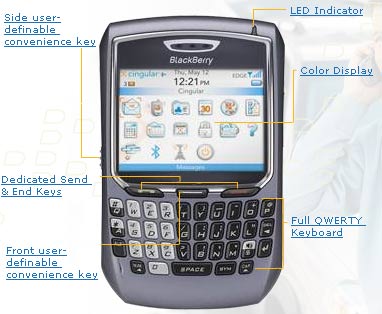
DoCoMo's Blackberry: Q&A with Research in Motion JapanThe pending Japan arrival of Research in Motion (RIM)’s hyperpopular BlackBerry email device, widely known as the ‘CrackBerry’ for its simple, efficient and addictive delivery of corporate email, will inject a new dimension into this country’s complex device and service matrix.
A wise move or a sign of desperation? These two viewpoints seem to characterize media, pundits’ and bloggers’ responses to last month’s announcement that DoCoMo would bring the BlackBerry email device into Japan, in partnership with RIM, based in Canada. Our own take on it was: Who Cares? WWJ was mindful that “virtually everyone in Japan’s workforce already has an always-on, fully connected email device right in their back pocket — in other words, a phone!”

Furthermore, before and since then, there has been more news, helping make it even more difficult to assess the BlackBerry’s prospects.

According to the pundits, NTT DoCoMo’s decision to import the BlackBerry is either (a) a master stroke aimed at securing the giant carrier’s corporate mobile offerings as 3G competition heats up in 2006/07, or (b) expensive folly that will see enterprise sales teams saddled with a clunky, ‘not-made-here’ device that competes poorly if at all against universal 3G phones that already receive push mail in real time, thank you very much (and some media reports have stated the first Japan BlackBerrys won’t even accept Japanese text input). The truth, however, is probably somewhere between these extremes, and so WWJ went straight to the source.


DoCoMo Working Towards Super 3G

DoCoMo has just announced that starting today it will accept proposals from suppliers for development of equipment for Super 3G base stations and handsets. DoCoMo will select one or more suppliers for each of these categories around October and aims to complete the technology with the selected suppliers before the end of 2009. The Super 3G standard is expected to provide superfast downlink data rates of over 100Mbps and uplink data rates of over 50Mbps, low-latency data transmission, and improved spectrum efficiency.

Sanyo Nokia Deal Called Off

Sanyo Electric has given up potentially lucrative plans announced in February to tie up on mobile handsets with Finnish giant Nokia as the firms had failed to reach a compromise. “The plan of setting up a joint venture with Nokia in CDMA mobile handsets is over, as both sides saw difficulty making concessions in sharing patent rights and other company assets,” Sanyo Electric spokesman Akihiro Oiwa said Thursday. The plan was one pillar of Sanyo’s restructuring efforts.

DoCoMo Seeking 3G Partner in China

NTT DoCoMo may seek partners in China after the Chinese government issues licenses for high-speed networks to expand in the world’s biggest mobile phone market. One of the standards, called W- CDMA, is the same as the platform adopted by DoCoMo in Japan. “We have to see what kind of technology the operators will use,” Takeshi Natsuno, senior vice president of multimedia services at Tokyo-based DoCoMo, said in an interview broadcast today. “After that, we can decide what kind of strategic alliance we’re going to make.”