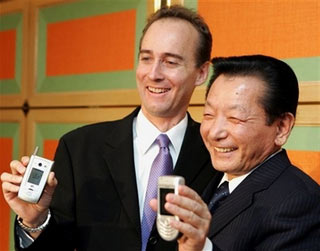
 Last week’s announcement of Nokia and Sanyo joining forces to boost their combined CDMA market share in the US was lost in the next-gen mobile TV hype and media avalanche (not to mention complaints about pokey dial-up access from the venue) coming from the 3GSM World Congress. The Nokia-Sanyo combination is an obvious play with both sides bringing a decent value proposition to the table; Nokia has massive manufacturing capacity, established distribution channels and a global brand while Sanyo has proven experience producing ultra-cool high-tech handsets and strong operator/vendor relationships. The companies gave no financial details of the tie-up, which is expected to close in the second quarter, but the JV will be based in Osaka and San Diego with an estimated 3,500 employees.
The challenge — and rewards — of morphing these respective ‘best of’ brands into a unified product offering are significant. Sanyo has advanced mobile battery and GPS chip expertise that even a Nokia would be hard-pressed to build on their own and such technologies are fast becoming key competitive differentiators as the US (and other markets) mandate emergency location reporting and other public safety services. Sanyo was vaulted to the ranks of top-tier suppliers to national champion DoCoMo last year as the name behind some of Big D’s first GPS-enabled models, the SA800i and SA700iS.
A Nokia-Sanyo tie-up makes sense from an economy of scale perspective and the end result should be better hardware for the end user, potentially at a lower price, which should please the operators and — more to the point — their shareholders.